
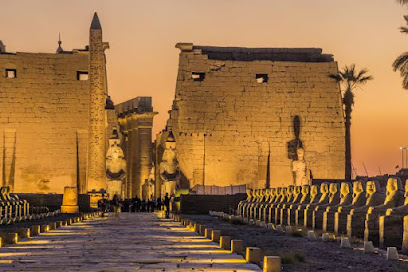
Luxor Temple stands at the heart of modern Luxor, yet it belongs to the ancient city of Thebes, one of the most powerful religious and political centers of pharaonic Egypt. Unlike many temples dedicated mainly to one local deity, Luxor Temple was closely connected with kingship, renewal, and the great religious ceremonies that linked it to Karnak Temple by a processional avenue.
The temple’s main construction is associated with Amenhotep III of the Eighteenth Dynasty, with later additions by Ramesses II and other rulers. Its long axis, elegant courts, colossal statues, obelisks, and carved walls tell a story of divine kingship. Ancient Egyptian rulers used temple architecture to present themselves as chosen by the gods, and Luxor Temple is one of the clearest places to see that idea in stone.
One of the most memorable features of the site is the way different historical periods appear together. Pharaonic reliefs, Roman-period spaces, later Christian traces, and the mosque of Abu al-Haggag built into the temple area all show how the monument remained meaningful across centuries. This continuity gives Luxor Temple a special atmosphere: it is both an ancient sanctuary and a living part of the city.
Luxor Temple is part of the UNESCO World Heritage property Ancient Thebes with its Necropolis. For travelers, it is especially beautiful at sunset and in the evening, when the illuminated columns and statues create a dramatic scene. A visit pairs perfectly with Karnak, because the two temples were historically and ceremonially connected. Together they help explain why Luxor is often described as an open-air museum of ancient Egypt.