Introduction to Alexandria: The Pearl of the Mediterranean
Alexandria, known as the "Bride of the Mediterranean" (Aroos El Bahr El Abiad El Motawassit), stands as Egypt's second-largest city and its primary seaport on the northern coast. Stretching along approximately 32 kilometers (20 miles) of the Mediterranean coastline, Alexandria presents a distinct blend of classical antiquity, European architectural influence, and modern urban coastal culture.
Founded in 331 BCE by Alexander the Great, the city rapidly grew to become the intellectual, cultural, and economic capital of the Hellenistic world. For centuries under Ptolemaic and Roman rule, Alexandria hosted renowned monuments of world history, including the Pharos Lighthouse—one of the Seven Wonders of the Ancient World—and the Great Library of Alexandria, the premier center of learning in antiquity.
In modern times, Alexandria remains a major economic engine for Egypt, accommodating vital commercial shipping ports and industrial zones. For travelers, the city provides a contrasting experience to the inland Pharaonic sites of Cairo, Luxor, and Aswan, offering mild maritime weather, Greco-Roman archaeological sites, historic waterfront promenades, and a rich culinary culture shaped by centuries of cross-Mediterranean commerce.
Historical Evolution: From Alexander the Great to the Modern Era
Alexandria's history spans over two millennia, marked by distinct epochs of imperial grandeur, intellectual leadership, and strategic maritime dominance.
Founding and the Ptolemaic Golden Age (331 BCE – 30 BCE): Alexander the Great commissioned the Greek architect Dinocrates to design the city on the narrow strip between the Mediterranean Sea and Lake Mareotis, incorporating the small native fishing village of Rhakotis. Following Alexander’s death, Ptolemy I Soter established the Ptolemaic Kingdom and declared Alexandria the capital of Egypt. Under Ptolemaic ruler patronage, the city developed into the premier intellectual capital of the ancient world, boasting the Pharos Lighthouse and the Mouseion with its Great Library.
Roman and Byzantine Rule (30 BCE – 641 CE): Following the downfall of Cleopatra VII and Mark Antony at the Battle of Actium (31 BCE), Octavian (later Augustus) annexed Egypt into the Roman Empire. Alexandria remained the empire's second most important city after Rome, serving as the grain storehouse of the Mediterranean. It also emerged as a major center of early Christian theology and scholarship, giving rise to prominent figures like Clement and Origen, as well as the Coptic Orthodox Church.
Islamic Conquest and Medieval Shift (641 CE – 1517 CE): In 641 CE, the Arab general Amr ibn al-Aas captured Alexandria. The political capital of Egypt subsequently moved inland to Fustat (modern Cairo). While Alexandria retained importance as a strategic naval fortress and trade port, its regional dominance diminished during the Mamluk and Ottoman eras, particularly after sea routes around Africa bypassed traditional Mediterranean trade.
19th-Century Resurgence under Muhammad Ali: In the early 1800s, Muhammad Ali Pasha initiated a massive revitalization of Alexandria. The excavation of the Mahmoudiyah Canal restored fresh water supply and inland transport connections to the Nile, while the construction of modern deep-water port facilities re-established Alexandria as Egypt’s primary commercial gateway. During the 19th and early 20th centuries, the city developed a celebrated cosmopolitan atmosphere, attracting Greek, Italian, French, Levantine, and British merchant communities.
Geography, Climate, and Best Time to Visit
Alexandria occupies a long, narrow coastal strip in northern Egypt, positioned between the Mediterranean Sea to the north and Lake Mareotis (Mariout) to the south. The layout of the city center revolves around two natural bays—the East Harbour and the West Harbour—divided by a T-shaped peninsula. This peninsula evolved around the ancient Heptastadion, a 1.2-kilometer causeway built in antiquity to connect the mainland with Pharos Island.
The city experiences a Mediterranean climate characterized by mild, rainy winters and warm, humid summers. Unlike Egypt’s interior regions, Alexandria benefits from constant maritime breezes that temper extreme heat:
Winter (December to February): Mild daytime temperatures typically range from 18°C to 20°C, falling to around 10°C at night. Winter brings significant precipitation and periodic coastal winter storms locally known as Nawat, which bring high winds and heavy rain.
Spring (March to May): Pleasant temperatures average between 20°C and 26°C. Clear skies predominate, though occasional dust-laden Khamaseen winds occur during early spring.
Summer (June to August): Daytime temperatures hover between 28°C and 31°C, accompanied by high relative humidity often exceeding 70%. Summer represents peak domestic beach season, attracting millions of visitors from across Egypt.
Autumn (September to November): Considered by many as the ideal season, autumn offers comfortable daytime temperatures between 22°C and 28°C, declining humidity, warm Mediterranean waters, and minimal rainfall.
Best Time to Visit: For international travelers and culture-focused sightseeing, the optimum visitation windows are autumn (October to November) and spring (March to May). These shoulder periods combine pleasant walking weather with manageable crowd levels at major heritage sites.
Ancient Wonders & Submerged Heritage
Alexandria was home to one of the most famous monuments of antiquity: the Pharos Lighthouse. Constructed in the 3rd century BCE during the reigns of Ptolemy I and Ptolemy II, and designed by the Greek architect Sostratus of Cnidus, the lighthouse stood over 100 meters high on the eastern tip of Pharos Island. Recognized as one of the Seven Wonders of the Ancient World, it utilized a massive bronze mirror to reflect sunlight by day and a fire by night, guiding Mediterranean shipping into Alexandria’s harbours for over a millennium before being destroyed by a series of earthquakes between the 10th and 14th centuries.
In recent decades, marine archaeology has revealed that much of ancient Alexandria lies beneath the surface of the Mediterranean. Pivotal underwater excavations led by the European Institute for Underwater Archaeology (IEASM), under Franck Goddio, and the Centre d'Études Alexandrines (CEAlex), founded by Jean-Yves Empereur, have mapped extensive submerged ruins in Alexandria's Eastern Harbour and nearby Aboukir Bay:
The Sunken Royal Quarter: Investigations in the Eastern Harbour have uncovered the submerged island of Antirhodos, believed to be the site of Cleopatra VII’s royal palace complex, complete with red granite columns, sphinxes, and statues of Ptolemaic rulers.
Submerged Cities of Aboukir Bay: Excavations in Aboukir Bay revealed the ancient port cities of Thonis-Heracleion and Canopus, which sank into the sea in the 8th century CE due to soil liquefaction and rising sea levels. Discoveries include monumental 5-meter-tall statues of the god Hapi, temple complexes, ritual vessels, and dozens of ancient shipwrecks.
These underwater archaeological sites form one of the world's most significant marine heritage areas, with select artifacts displayed in Alexandria's museums and international exhibitions.
The Citadel of Qaitbay: Fortress on the Pharos Foundations
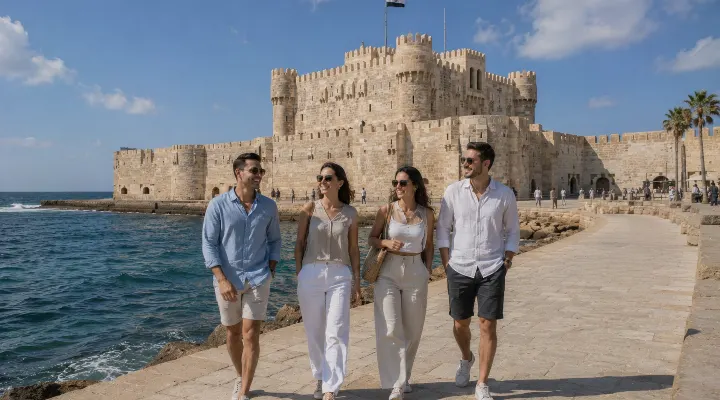
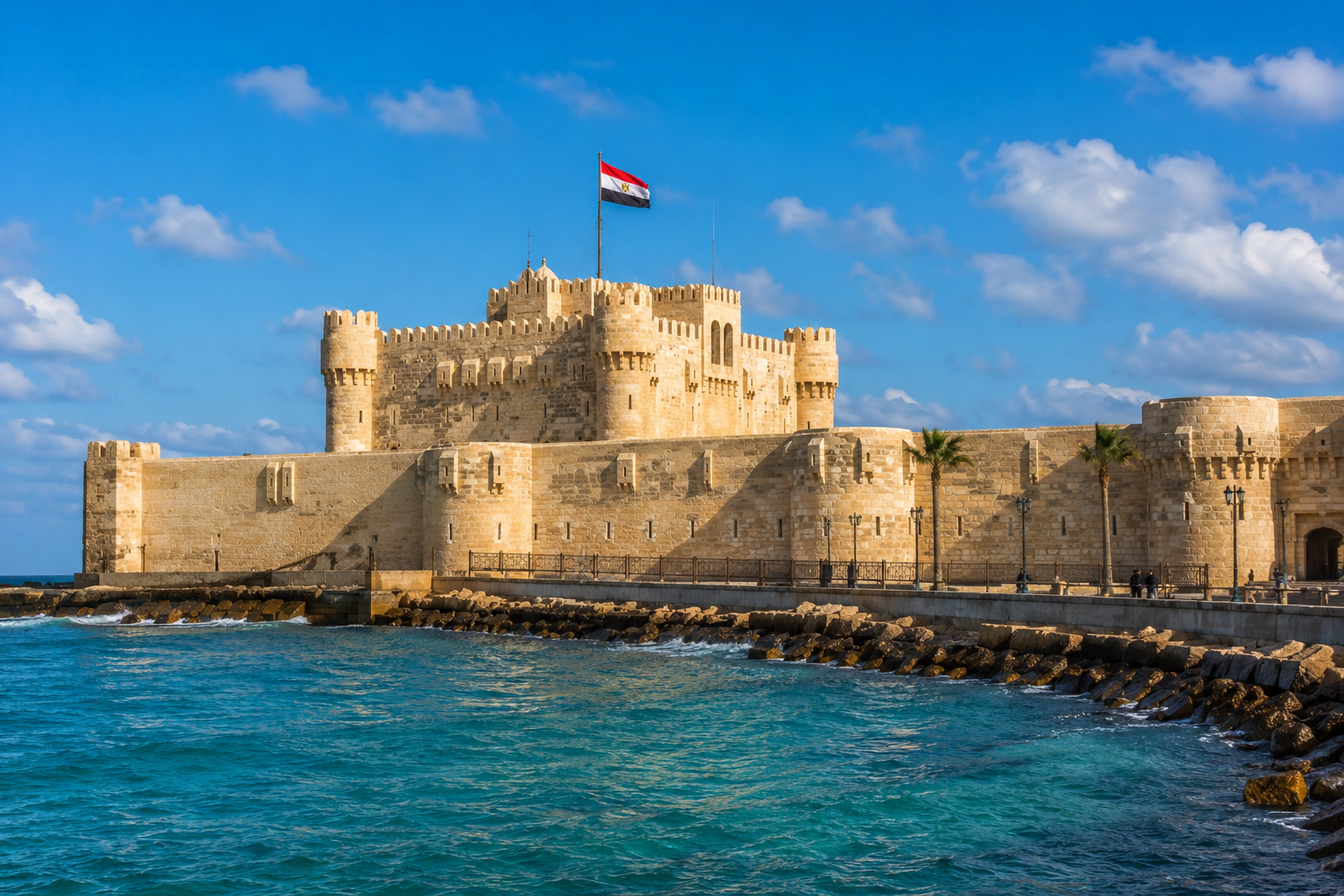
Standing at the entrance of Alexandria’s Eastern Harbour, the Citadel of Qaitbay is one of the most important defensive strongholds along the Mediterranean coast. Commissioned in 1477 CE (882 AH) by the Mamluk Sultan Al-Ashraf Sayf al-Din Qa'itbay, the fortress was constructed to fortify Egypt’s northern maritime borders against the growing naval power of the Ottoman Empire.
The citadel was erected precisely on the northern tip of Pharos Island, occupying the exact site where the ancient Pharos Lighthouse once stood. Following the lighthouse’s destruction by earthquakes during the 11th through 14th centuries, Mamluk builders repurposed its surviving granite columns, red granite blocks, and heavy masonry to construct the fortress walls and interior structures.
Architecturally, the Citadel of Qaitbay features a classic medieval Islamic military design:
Outer and Inner Walls: The complex is enclosed by defensive outer walls reinforced with circular watchtowers, designed to accommodate artillery installations and archers.
The Central Keep: The heart of the fortress is a three-story square tower built from local limestone. The keep houses soldiers' quarters, ammunition stores, strategic lookout posts, and an inner courtyard.
The Mamluk Mosque: Located on the main floor of the keep is a compact, open-plan mosque featuring traditional Mamluk stone carving and arched niches, recognized as one of the oldest surviving mosques in Alexandria.
Over the centuries, the citadel underwent multiple repairs, notably under Sultan al-Ghawri and later Muhammad Ali Pasha, who refitted it with modern artillery in the 19th century. Restored extensively by the Comité de Conservation des Monuments de l'Art Arabe in the 20th century, the citadel now operates as a historical museum and major tourist attraction, offering sweeping panoramic views of the Mediterranean Sea and Alexandria's coastal skyline.
Bibliotheca Alexandrina: Revival of Knowledge and Culture
Inaugurated in 2002, the Bibliotheca Alexandrina stands as a major cultural institution and architectural landmark on Alexandria's shoreline, built near the historic site of the ancient Great Library. Designed by the Norwegian architectural firm Snøhetta following an international UNESCO competition, the building features a striking 160-meter-wide disk tilted toward the Mediterranean Sea, symbolizing a rising sun illuminating the sea of knowledge.
The library's exterior wall is crafted from massive gray granite blocks quarried in Aswan, carved with characters, symbols, and alphabets representing over 120 human scripts. Inside, the complex centers around an 11-story cascading main reading room covering 20,000 square meters, supported by slender lotus-shaped concrete columns and illuminated by custom-engineered skylights that filter indirect sunlight.
Beyond its vast book collections, the Bibliotheca Alexandrina functions as a multi-disciplinary cultural complex hosting:
Specialized Libraries: Dedicated sections including the Children’s Library, Young Adult Library, Taha Hussein Library for the Visually Impaired, and the Rare Books and Special Collections Library.
Specialized Museums: Four integrated museums, including the Antiquities Museum (displaying underwater and terrestrial artifacts), the Manuscripts Museum, the History of Science Museum, and the President Sadat Museum.
Cultural and Research Facilities: A state-of-the-art Planetarium, multiple art galleries, permanent research centers, international conference facilities, and digital preservation laboratories housing a mirror of the Internet Archive.
Greco-Roman Landmarks: Kom El Shoqafa, Pompey's Pillar, and Beyond
Alexandria features some of the Mediterranean region's most significant surviving Greco-Roman monuments, showcasing a unique architectural fusion of Egyptian motifs with classical Greco-Roman designs.
Catacombs of Kom El Shoqafa: Constructed in the 2nd century CE, this extensive underground necropolis spans three tiers carved directly into bedrock, reaching a depth of over 30 meters. Originally built for a single wealthy family, it later expanded into a mass burial site. The catacombs represent a rare artistic synthesis, featuring relief sculptures that depict Roman gods dressed in Pharaonic royal attire and traditional Egyptian funerary deities (such as Anubis and Osiris) styled with classical Hellenistic postures. Highlights include the Rotunda, the Triclinium (a banqueting hall for funerary feasts), the Principal Tomb Chamber, and the Hall of Caracalla.
Pompey's Pillar & The Serapeum: Dominating a hill in the Carmous district, Pompey's Pillar is a massive monolithic column crafted from solid red Aswan granite. Standing roughly 27 meters high (including base and capital) with a shaft weighing over 285 tons, it was erected in 297 CE by Roman Prefect Publius in honor of Emperor Diocletian to commemorate his victory and relief aid to the city. Misnamed by Crusaders who believed Pompey was buried above it, the column sits within the sanctuary precinct of the Serapeum—the principal temple dedicated to Serapis, the syncretic Greco-Egyptian deity created by Ptolemy I.
Kom El Dikka Archaeological Site & Roman Amphitheatre: Located in the city center, Kom El Dikka contains Egypt's only discovered Roman theatre. Uncovered accidentally in 1960 during building excavations, the horseshoe-shaped marble theatre features 13 tiers of white Italian marble seating that accommodated up to 800 spectators. The surrounding complex includes Roman public bathhouses (thermae), complex drainage systems, a residential quarter housing the "Villa of the Birds" (celebrated for its intact 2nd-century mosaic floors depicting birds), and 22 rectangular lecture halls (auditoria) that formed part of an ancient academy or university.
Greco-Roman Museum: Reopened following an extensive restoration, the museum displays over 10,000 artifacts spanning from the Alexander the Great era through the Byzantine period. Its collection includes marble statues of deities and emperors, mosaic pavements, Hellenistic coins, terracotta figurines, and funerary art documenting centuries of multicultural interaction.
Royal Palaces and Gardens: Montaza and Ras El Tin
Alexandria’s royal heritage is showcased in its palatial estates and manicured gardens along the Mediterranean shore, serving as reflections of Egypt’s 19th- and 20th-century monarchy.
Montaza Palace Complex and Gardens: Situated on a high pine-forested bluff overlooking the sea on Alexandria’s eastern coast, the Montaza complex spans approximately 360 acres. Established in 1892 by Khedive Abbas II as a summer residence, the grounds contain two primary palaces surrounded by landscaped gardens, palm groves, and private coastal coves.
Salamlek Palace: Built in 1892 as a hunting lodge and residence, featuring Neo-Renaissance and Ottoman architectural accents. It was later converted into a luxury historic hotel.
Al-Haramlik Palace: Constructed in 1932 by King Fuad I, this expansive palace blends Florentine Renaissance and Moorish revival architectural styles. Its iconic tower was modeled after the Palazzo Vecchio in Florence.
Montaza Gardens & Cove: The public gardens house rare plant species, stone bridges, an offshore island with a historic teahouse, and historic lighthouse structures, making it a prominent recreational destination.
Ras El Tin Palace: Positioned on the western tip of Alexandria's harbor, Ras El Tin is the oldest royal palace in Egypt still in active state use. Construction was initiated in 1834 by Muhammad Ali Pasha and completed in 1847. Designed in a classical Italian Renaissance style with Islamic decorative details, the palace has served as the scene of pivotal historic events—most notably the abdication of King Farouk I on July 26, 1952, following the Egyptian Revolution, after which he departed Egypt from the palace's private pier aboard the royal yacht El Mahrousa. Today, it functions as an official presidential residence and naval facility.
Religious and Cultural Landmarks: Mosques, Churches, and Museums
Alexandria's spiritual and artistic landscape reflects millennia of multicultural coexistence, housing key monuments of Islamic, Christian, and Jewish heritage alongside world-class museum collections.
Abu al-Abbas al-Mursi Mosque: Located in the Anfoushi neighborhood near the Eastern Harbour, this iconic mosque is dedicated to the 13th-century Andalusian Sufi saint Shihab al-Din Abu al-Abbas al-Mursi. Originally built over his tomb in 1307, the present grand structure was designed in the 1930s by Italian architect Mario Rossi. Featuring cream-colored stone, intricate cream-and-gold domes, Arabesque carvings, and an octagonal minaret rising 73 meters, it stands as a masterpiece of modern Islamic architecture and the center of Alexandrian Sufism.
Saint Mark's Coptic Orthodox Cathedral: Situated in the Ramleh district, Saint Mark's is historically recognized as the seat of the Coptic Orthodox Pope and the oldest Christian site in Egypt. According to church tradition, Saint Mark the Evangelist established the Church of Alexandria in 42 CE and was martyred here. While rebuilt multiple times following destruction across the centuries, the modern cathedral houses the traditional burial vault of Saint Mark's head and features expansive marble iconostasis work, Coptic mosaics, and historic papal artifacts.
Eliyahu Hanavi Synagogue: Located on Nabi Daniel Street, this 19th-century synagogue is one of the largest in the Middle East and a testament to Alexandria’s historic Jewish community. Originally constructed in the 14th century and rebuilt in 1850 by French architect Léon Barcilon, the synagogue features Neo-Renaissance architecture, soaring green marble columns, stained-glass windows, and carved wooden ark seating housing ancient Torah scrolls. It underwent complete structural restoration by the Egyptian Ministry of Tourism and Antiquities in 2020.
Alexandria National Museum: Housed in a restored Italianate villa formerly owned by wood merchant Asaad Bassili, this museum presents Alexandria’s history in chronological sequence across three floors:
Basement (Pharaonic Era): Statuary, mummification artifacts, and relief carvings from ancient Egypt.
Ground Floor (Greco-Roman Era): Sunken antiquities from Aboukir Bay, marble busts of Alexander the Great and Roman emperors, and Hellenistic funerary art.
Upper Floor (Coptic, Islamic, and Modern Eras): Coptic textiles, Islamic coins and wooden screens, and 19th-century royal heirlooms.
Royal Jewelry Museum: Located in the Zizinia district within the 1930s neo-Baroque palace of Princess Fatima Al-Zahra, the museum displays an opulent collection of over 11,000 items owned by the Muhammad Ali Dynasty. Highlights include diamond-encrusted crowns, emerald-set pocket watches, gold chess sets, and decorative objets d'art set against hand-painted ceiling frescoes and stained-glass interiors.
The Alexandria Corniche, Beaches, and Waterfront Experience
Alexandria’s identity is inextricably bound to its waterfront promenade, known locally as the Corniche (officially 26th of July Avenue). Extending along the curving Mediterranean coastline from the Citadel of Qaitbay and Ras El Tin in the west to the Montaza Palace precinct in the east, the Corniche serves as both the city's main arterial road and its primary social gathering space.
Originally engineered in the late 19th and early 20th centuries and significantly expanded over subsequent decades, the promenade is framed by historic early 20th-century European-style architecture, classic apartment blocks, seafood restaurants, and sidewalk cafes. Key highlights along the waterfront include:
Stanley Bridge (Kobri Stanley): Spanning Stanley Bay along the eastern section of the Corniche, this iconic 400-meter-long bridge features elegant Italianate towers and decorative arches. Opened in 2001 as part of coastal expansion efforts, it has become a celebrated architectural landmark and popular gathering spot for evening walks and photographic views over the Mediterranean.
Alexandria's Coastal Beaches: The city's coastline features a mix of public and private beaches. Notable spots include Maamoura Beach and Montaza Cove in the east, known for calmer waters and landscaped surroundings, as well as central urban beaches such as Sidi Bishr, Rushdy, Shatby, and Gleem.
The Eastern Harbour & Anfoushi Waterfront: The crescent-shaped Eastern Harbour offers a traditional maritime scene where colorful wooden fishing boats anchor in calm waters beneath the shadow of the Citadel of Qaitbay. Nearby, the historic Anfoushi district retains its traditional seafaring character, boatbuilding yards, and fish markets.
BLOG ARTICLE — PART 11
Culinary Scene: Fresh Seafood and Traditional Cafes
Alexandria’s culinary heritage is strongly defined by its coastal geography and Mediterranean cosmopolitan legacy. Seafood forms the core of Alexandrian dining, centered on daily fresh catches brought in from the Mediterranean Sea and Lake Mariout.
Traditional preparation methods highlight the natural flavor of the catch. The most famous local style is Singari—butterflied fish seasoned with garlic, herbs, peppers, and tomatoes before being oven-roasted on aluminum foil. Other popular preparations include charcoal grilling (Mashwi) with bran crusts, deep-frying (Maqli), and slow-cooked seafood tagines (Tagen). The center of the city's seafood trade is the historic Anfoushi Fish Market (Souq El-Samak), where visitors and locals select fresh fish directly from vendors to be prepared at nearby local cooking establishments.
Beyond seafood, Alexandria is renowned across Egypt for its distinct street food culture:
Kebda Eskandarani (Alexandrian Liver): Finely sliced beef liver rapidly sautéed with green chili peppers, garlic, cumin, and lemon juice, typically served in soft French-style rolls (Eish Fino) with tahini.
Alexandrian Hawawshi: Unlike the Cairo version made with flatbread, Alexandrian Hawawshi features spiced minced meat baked inside raw yeast dough, creating a fresh, stuffed pastry.
The city’s historic cafes and patisseries preserve its 19th- and 20th-century Levantine and European Heritage. Venues around Ramleh Square and along the Corniche—such as Trianon, Délices, Pastroudis, and Athineos—were established by Greek, Italian, and French expatriates. Featuring original Art Deco fixtures, wooden paneling, and mirrored halls, these salons continue to serve traditional Egyptian pastries, Greek sweets, and European coffee.
Visitor Practical Guide: Getting There and Getting Around
Navigating travel to and within Alexandria is straightforward due to its position as a major transport hub connected to Cairo and regional Mediterranean destinations.
Getting to Alexandria:
By Air: Borg El Arab International Airport (HBG), situated approximately 40 kilometers southwest of the city center, serves as the main aviation gateway, offering domestic flights from Cairo and international connections across the Middle East, North Africa, and Europe.
By Train: Egyptian National Railways operates frequent passenger services between Cairo's Ramses Station and Alexandria's two primary stations: Misr Station (Station de Misr in downtown) and Sidi Gaber Station. Options range from luxury express services (such as modern Talgo trains, taking roughly 2 to 2.5 hours) to standard VIP and speed trains.
By Road: The city is connected to Cairo via two major routes: the Cairo-Alexandria Desert Road (Highway 75) and the Cairo-Alexandria Agricultural Road. Long-distance intercity bus operators (such as Go Bus, Superjet, and West Delta) provide frequent, comfortable daily services, while private hire vehicles and microbuses run continuously.
Getting Around the City:
Alexandria Tramway: In operation since 1860, Alexandria’s electric streetcar network is among the oldest continuously operating tram systems in the world. Divided into the Yellow Trams (serving inner neighborhoods) and the Blue Trams (connecting Ramleh Station to eastern suburbs like Victoria), it offers an affordable and iconic transit option.
Ride-Hailing & Taxis: Local taxis, traditionally painted yellow and black, are widely available throughout the city. Additionally, major international ride-hailing platforms (including Uber, Careem, and inDrive) operate extensively across Alexandria, providing upfront pricing and GPS tracking.
Microbuses & Walking: Microbuses run frequent routes along main thoroughfares, particularly along the Corniche and Tram/Abou Kir street corridors. Central districts—including the Corniche promenade, Ramleh Square, and the historic downtown area—are highly walkable and easily accessible on foot.